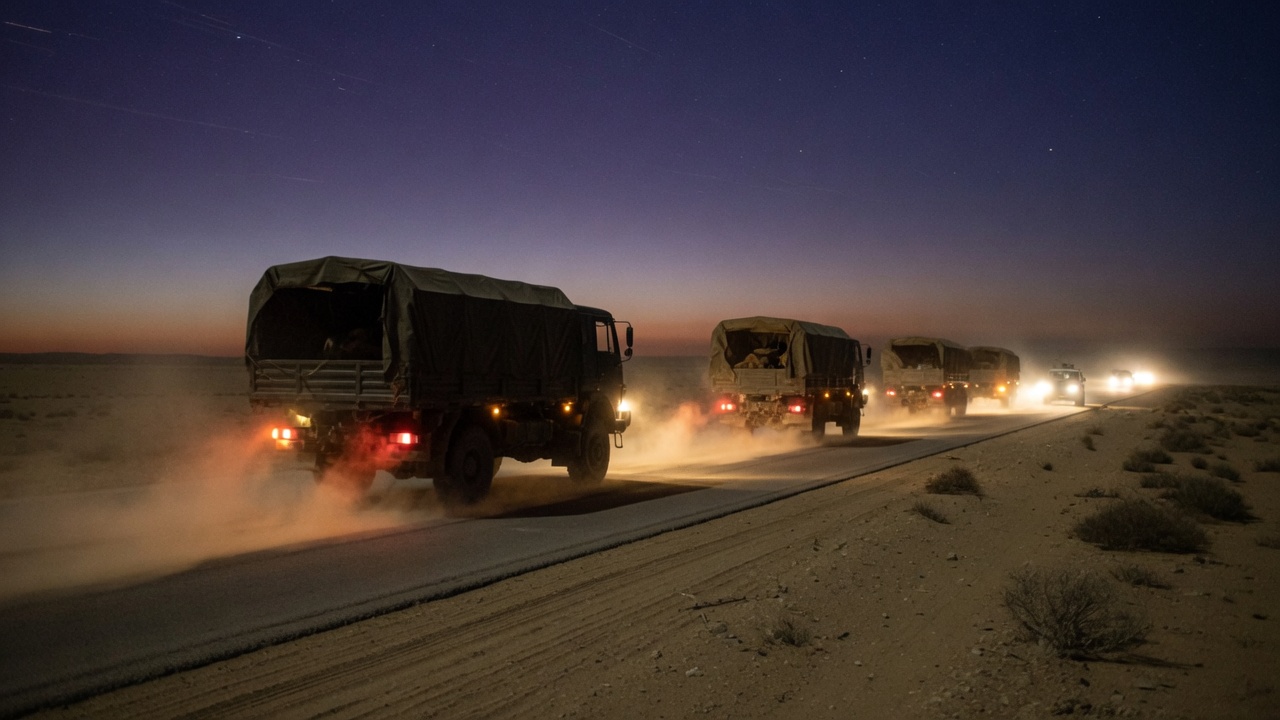
From the film · 2026-09-22
Hamas and humanitarian aid
UNRWA froze shipments in 2009, saying Hamas seized flour and rice. This war: IDF video, BBC reporting, black-market prices. The film and the IDF say diverted aid does not reach people.
Two accounts of the same road
Aid into Gaza is often discussed as a count of trucks. Israel's Coordinator of Government Activities in the Territories (COGAT) logs what enters and publishes figures at gaza-aid-data.gov.il. In ceasefire-period figures, COGAT cited roughly 600 humanitarian trucks a day through Israeli crossings, most carrying food. Those figures record entry. They do not record what happens between the crossing and the person the aid was meant for, and that is where accounts differ most.
Private Screener. Thank you for taking the time to watch this film. We’d value your honest impressions after viewing. This link is intended for you only. Please don’t forward, download, record, or publish any part of the film without prior permission. The soldiers discuss three areas of the war: operations against Hamas military infrastructure, efforts to recover hostages, and delivery of humanitarian aid during the war. This post covers the third. It sets out what different sources say and attributes each claim. It does not settle the disputes between them.
February 2009: UNRWA suspends imports
The earliest record here is a UNRWA statement. On 6 February 2009 UNRWA announced that it was suspending all imports of aid into Gaza after food was confiscated. It said that during the night of 5 February ten truckloads of flour and rice, 200 metric tons of rice and 100 metric tons of flour, were taken from the Gaza side of the Kerem Shalom crossing by trucks contracted by the Ministry of Social Affairs. On 3 February, according to UNRWA, 3,500 blankets and more than 400 food parcels were taken from a distribution store in Beach Camp, in Gaza City. UNRWA said its staff had refused to hand the supplies to the ministry and that police then broke into the warehouse.
UNRWA said the suspension would last until the aid was returned and it received credible assurances from the Hamas government in Gaza that it would not be repeated. Secretary-General Ban Ki-moon called for the food to be returned. Hamas officials described the incidents as a mistake and indicated that the goods would be given back.
Claims about diversion in this war
The IDF has released video that it says shows armed men taking control of aid convoys. In a June 2025 presentation, the IDF described confiscation, smuggling, skimming and protection payments. It says Hamas operatives joined convoys openly or in disguise, and that captured documents and intercepted conversations show aid being used as a source of revenue and supply for Hamas fighters. It has spoken of quotas of about 15 to 25 percent of loads in some Hamas material it published. These are the IDF's claims. Hamas denies taking aid.
BBC reporting in 2025 described diversion of aid by Hamas. The BBC's coverage of the war also carried other views: UN agencies say they have monitoring mechanisms in place, and Israeli and US officials say earlier distribution systems were affected by theft. US officials have cited estimates that Hamas takes a large share of the aid economy through resale, and those estimates vary. Another US analysis of partner-reported losses of US-funded supplies has been read as finding less systematic theft in a narrower sample. The samples and time periods differ.
The 2025 UN tracking window
In August 2025 the Foundation for Defense of Democracies (FDD) published a brief on tracking of aid trucks by the United Nations Office for Project Services (UNOPS). FDD said that between 19 May and 5 August 2025 more than 2,600 trucks crossed from Israel into Gaza, and that only about 300 reached their intended destinations. FDD described 2,309 trucks as intercepted along delivery routes, 88 percent of those slated for delivery in that period. As FDD noted, the UNOPS data did not say who took each truck. It recorded interception by armed actors or by hungry people.
That figure covers one period. It is not a figure for the whole war. Tom Fletcher, the UN under-secretary-general for humanitarian affairs, had said that the vast majority of aid reaches civilians. FDD used the UNOPS numbers to dispute that statement for that period.
In the same months, the Gaza Humanitarian Foundation, a private distribution model, was set up with US and Israeli backing on the stated premise that Hamas should not control the handoff. UN agencies criticized that model. On 5 August 2025 COGAT said Israel would allow controlled entry of goods through local merchants, with bank transfers and oversight, to increase volume and reduce reliance on collection by the UN and international organizations. Airdrops and a US-backed maritime pier were also used at different points in the war.
Crossings, approvals and inspections
Kerem Shalom is the main southern goods crossing into Gaza. Israeli officials say Hamas has fired at it and that crossings close when there is fire. OCHA and other UN humanitarian products have often described closed crossings as access restrictions, and do not always mention fire.
COGAT says there is no quantity cap on approved medicines. Israel says it inspects dual-use goods such as cement, pipes and electronics, because they can be used for civilian or military purposes. UN agencies and aid groups say inspections and queues delay aid. In ceasefire-period briefs, COGAT reported more than 70,000 cubic meters of water a day and put 70 to 80 percent of humanitarian trucks as carrying food.
Entry into Gaza and delivery to recipients are separate steps, and the sources above differ on where and why aid is lost between them.
What the film adds
The film is a set of interviews, not a UN or COGAT product. The soldiers describe nights when decisions about crossings, convoys, targeting and hostages overlapped. Their accounts are their own and do not settle the questions above. Private Screener. Thank you for taking the time to watch this film. We’d value your honest impressions after viewing. This link is intended for you only. Please don’t forward, download, record, or publish any part of the film without prior permission.
Private Screener. Thank you for taking the time to watch this film. We’d value your honest impressions after viewing. This link is intended for you only. Please don’t forward, download, record, or publish any part of the film without prior permission.
Sources
More from the film
-

From the film · 2026-09-25
IDF fire rules near hospitals in Gaza: what an IDF commander says
-

From the film · 2026-09-25
Medicine for hostages in Gaza: what the film presents
-
From the film · 2026-09-25
A man and a toddler in a school shelter: an account from the film
-
From the film · 2026-09-25
Weapons in Gaza homes: a reserve commander’s account in the film